A custom straw hat lives or dies on two decisions you make before anyone stitches a logo onto it: the straw you pick and the way you attach your branding to a surface that is, by design, full of holes. Get those right and a giveaway hat survives a full season of sun, sweat, and being crammed into a beach bag. Get them wrong and the logo puckers, the brim sags after one rain, and the batch looks cheap in every photo. This walkthrough covers how to specify an order that holds up, in the order the decisions actually matter.
Start with the straw, not the logo
The word “straw” covers a dozen very different materials, and the gap between them is larger than most first-time buyers expect. Toyo is the workhorse of promotional straw headwear: originally a Japanese paper-based straw, now woven across Asia, it is lighter than most natural straws and noticeably cheaper than premium options, which is why it dominates the western summer and cowboy styles you see at events. Paper braid and Shantung (a paper-and-fiber blend) are lighter still and take a uniform dye well, so a run of hats in a brand color looks consistent from unit to unit.
Natural fibers cost more and read as more premium. Seagrass has a greenish-gray, earthy look and a medium-coarse weave; raffia, from the African raffia palm, has a distinctly textured, tropical character; palm and sisal are coarser and tougher. At the top sits genuine toquilla, the Ecuadorian fiber behind true Panama hats, where the finest hand-woven grades exceed 2,000 weaves per square inch and price into the hundreds or thousands of dollars per hat. That grade almost never makes sense for branded merchandise, but it explains why “straw hat” quotes can range so wildly. For most logo programs the practical choice is toyo or paper braid for volume and budget, or seagrass and raffia when the hat is a retail or premium gift item. One point worth confirming rather than assuming: tighter, finer weaves generally block more sun, but a hat only carries a real UPF rating if the maker has tested it, so ask for the number instead of taking “sun hat” at face value.
Decoration methods that hold on a woven surface
Straw is the reason you cannot decorate these hats like a cotton cap. Running embroidery directly into an open weave tends to distort the straw and leave gaps, so the reliable methods build the logo on a carrier and mount that to the hat. Patches are the default: woven patches give a clean, flat, detailed logo; leather or faux-leather patches, often heat-stamped or debossed, suit western and outdoor brands; and 3D or PVC patches add dimension. A patch sewn or riveted to the front crown gives you a crisp logo regardless of how coarse the straw underneath is.
The other proven route is the hat band, which many buyers underuse. A grosgrain ribbon, printed cotton band, leather band, or rope cord in your brand colors wraps the crown and reads as intentional design rather than a slapped-on logo, and it is often the cheapest way to color-match a brand. For full-color art, decorators print the underbrim — the hidden underside of the brim — by sublimation for photographic, edge-to-edge patterns or by screen printing for bold solid-color graphics; it is a surprise-and-delight surface that photographs well without cluttering the crown. A woven interior label finishes the hat for retail. Mixing two of these (say, a front patch plus a branded band) usually looks better than trying to force one large logo onto the crown.
Shape, brim, and fit
Silhouette decides who will actually wear the hat. A western or cowboy crown with a shaped brim suits ranch, country-event, and outdoor-brand audiences; a wide-brim lifeguard or sun style (brims commonly run four to five inches) is the choice for beaches, pools, and outdoor hospitality; a fedora or boater reads dressier for resorts and weddings. Brim width is not just style — a wider brim shades more but packs and ships less easily, which matters for both freight and how people carry it.
Fit is where giveaway hats quietly fail. Rigid straw does not stretch like a knit beanie, so a single “one size” molded hat leaves a chunk of your audience with a hat that perches or pinches. Look for sized runs (roughly S through XL by head circumference) for anything premium, or an internal drawstring and sweatband on volume hats so wearers can snug the fit themselves. Confirm the sweatband material too; a moisture-wicking band is the difference between an all-day hat and one that gets taken off after an hour.
Minimums, price, and lead time
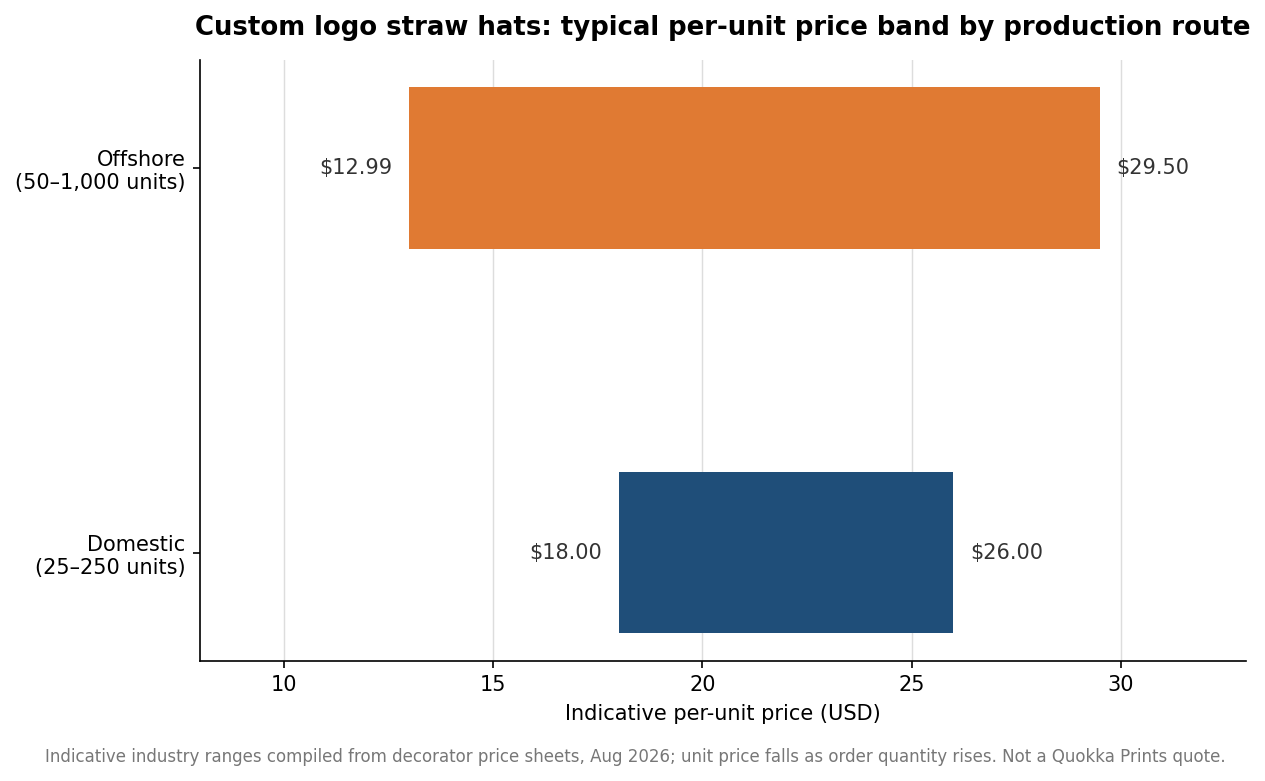
Custom straw headwear has become far more accessible for small runs. Minimums now commonly start around 25 units for domestic decoration, so pilot orders and small events are workable rather than requiring a thousand-piece commitment. Per-unit price tracks with both the decoration method and the quantity: domestic runs of roughly 25 to 250 units land in the mid-to-high teens up to the mid-twenties per hat, while offshore production across 50 to 1,000 units spans a wider band depending heavily on freight choice. The chart below shows the typical spread; treat these as indicative industry ranges, not a fixed quote, and expect the per-unit number to fall as volume rises.
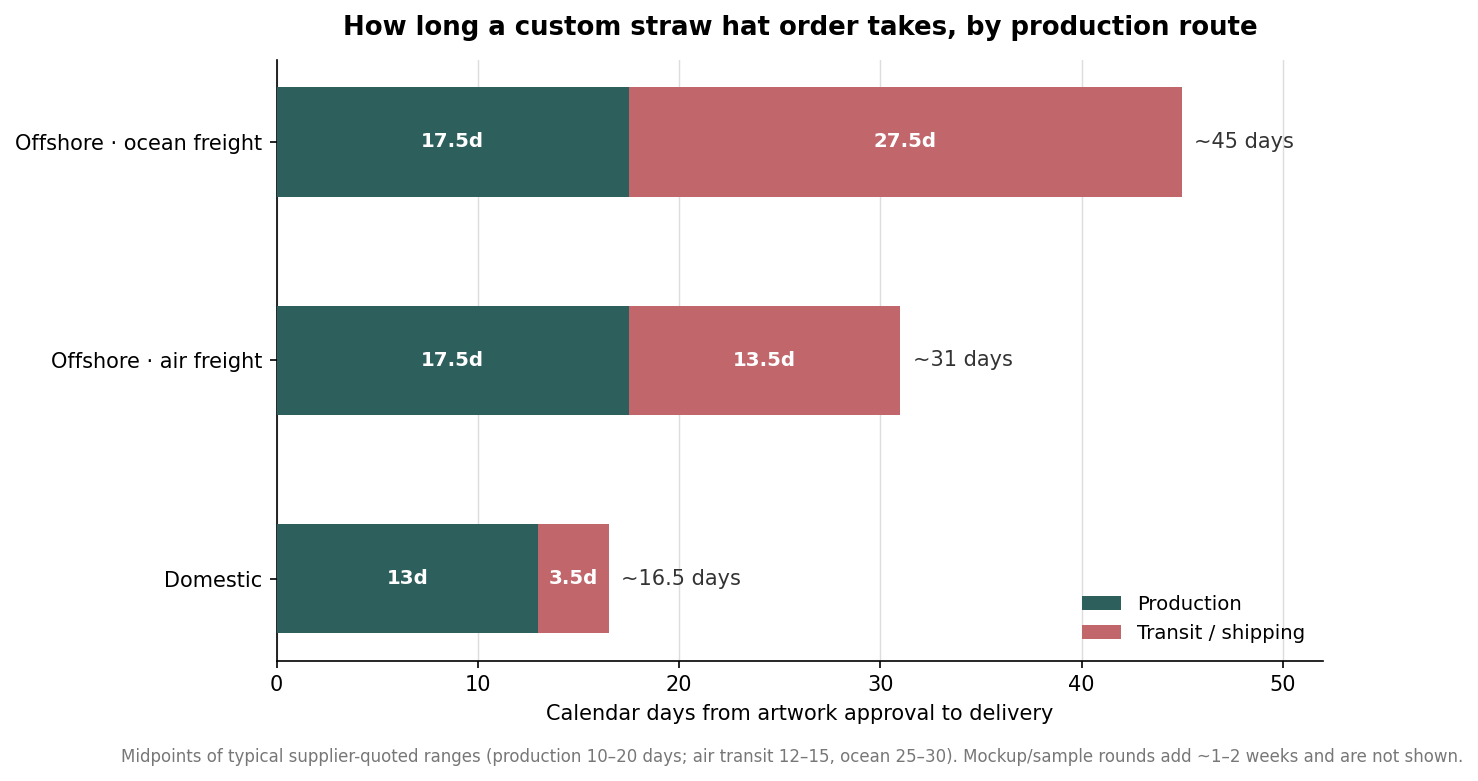
Lead time is the number that catches event planners out, because it is really two numbers stacked together: production plus transit. Domestic decoration on blank hats already in the country is the fast path, often delivering in roughly two to three weeks including shipping. Offshore production adds ocean or air freight on top of a longer build, and the freight choice swings the calendar by weeks. If you are printing for a dated event, back-plan from the event and add a mockup and sample round — usually another one to two weeks — before production even starts.
A spec you can hand to a supplier
Put the decisions in writing and quotes come back faster and more comparable. A tight brief names the straw and grade (for example, “smooth toyo, natural”), the style and brim width, the sizing approach (sized run or one-size with drawstring), the decoration method and placement (for example, “3.5-inch woven front patch plus grosgrain band in PMS 289”), your quantity and any size breakdown, your in-hand date, and whether you want a physical sample before the full run. Ask specifically whether the quoted straw is natural or synthetic, whether any UPF rating is tested, and what the reorder lead time looks like if the hats perform. Spend your attention on the straw and the mounting method, keep the logo treatment simple and well-placed, and a custom straw hat stops being a throwaway and starts being something people actually keep wearing.