A straw hat looks like sun protection. Whether it delivers sun protection is a different question, and for anyone ordering hats in bulk for staff, guests, or an outdoor crowd, it is the question that matters. The gap between a hat that shades a face and a hat that quietly lets a sunburn through comes down to a few measurable things: the tightness of the weave, the width of the brim, the color of the straw, and whether the batch was ever tested against a recognized standard. Here is what each of those factors actually does, and how to write them into an order so the hats you receive protect the people wearing them.
What UPF Really Measures
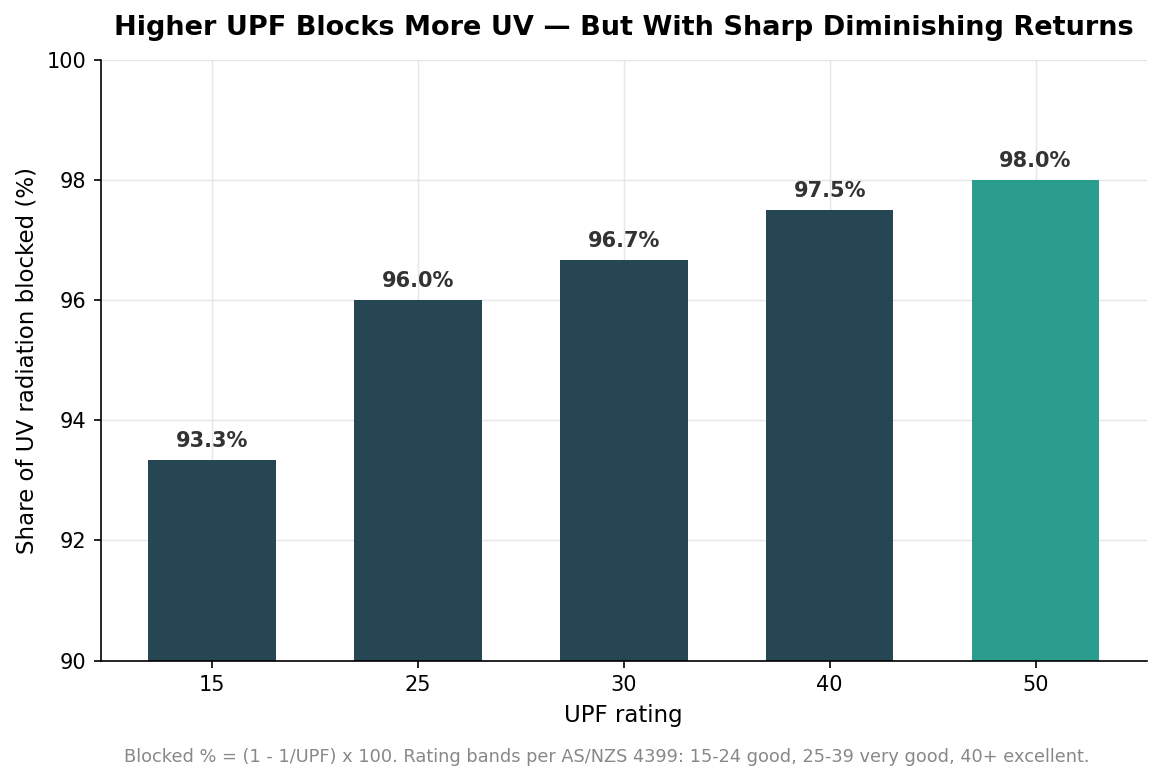
UPF stands for Ultraviolet Protection Factor, the textile equivalent of the SPF number on a sunscreen bottle. It describes how much of the sun’s ultraviolet radiation a material blocks. A UPF of 30 means that roughly one-thirtieth of the UV reaching the fabric passes through it — about 3.3 percent — so the material stops close to 97 percent. UPF 50 lets through one-fiftieth, or 2 percent, blocking 98 percent. That jump from 30 to 50 sounds large, but in real-world transmission it moves the needle by a little over a percentage point, which is worth remembering before paying a premium for the very top rating.
Under the Australian and New Zealand standard AS/NZS 4399 — the benchmark most testing labs reference and the one whose language shows up on hang tags worldwide — a rating of 15 to 24 is classed as good, 25 to 39 as very good, and 40 and above as excellent. Anything tested beyond 50 is labeled “UPF 50+” rather than given a larger number. The important caveat is that a UPF rating only means something when a lab has measured a sample of the actual material. A number printed next to a product with no test behind it is marketing, not data.
Why a Straw Hat’s Weave Decides Everything
Woven straw is not a solid fabric. It is a lattice, and UV travels straight through any gap in that lattice no matter how protective the individual fiber is. This is why straw hats vary so widely in practice: a tightly plaited paper braid or a densely woven toquilla can reach genuinely high UPF figures, while an open, airy weave with visible pinholes may block only a fraction of the UV that lands on it. Dermatologists describe a field test that needs no equipment at all — hold the hat up to a bright light, and if you can see daylight coming through the crown and brim, UV is coming through too.
Material choice sets the ceiling for how tight the weave can be. Paper braid and closely woven palm or seagrass tend to close up more than loose raffia or the deliberately vented styles built for airflow. There is a real trade-off buried here: the breathable, open weaves that feel best in heat are often the ones that let the most UV through. Decide which side of that trade-off your order needs before you settle on a material, because no amount of finishing will close gaps that the weave left open.
Brim Width Is the Other Half of the Equation
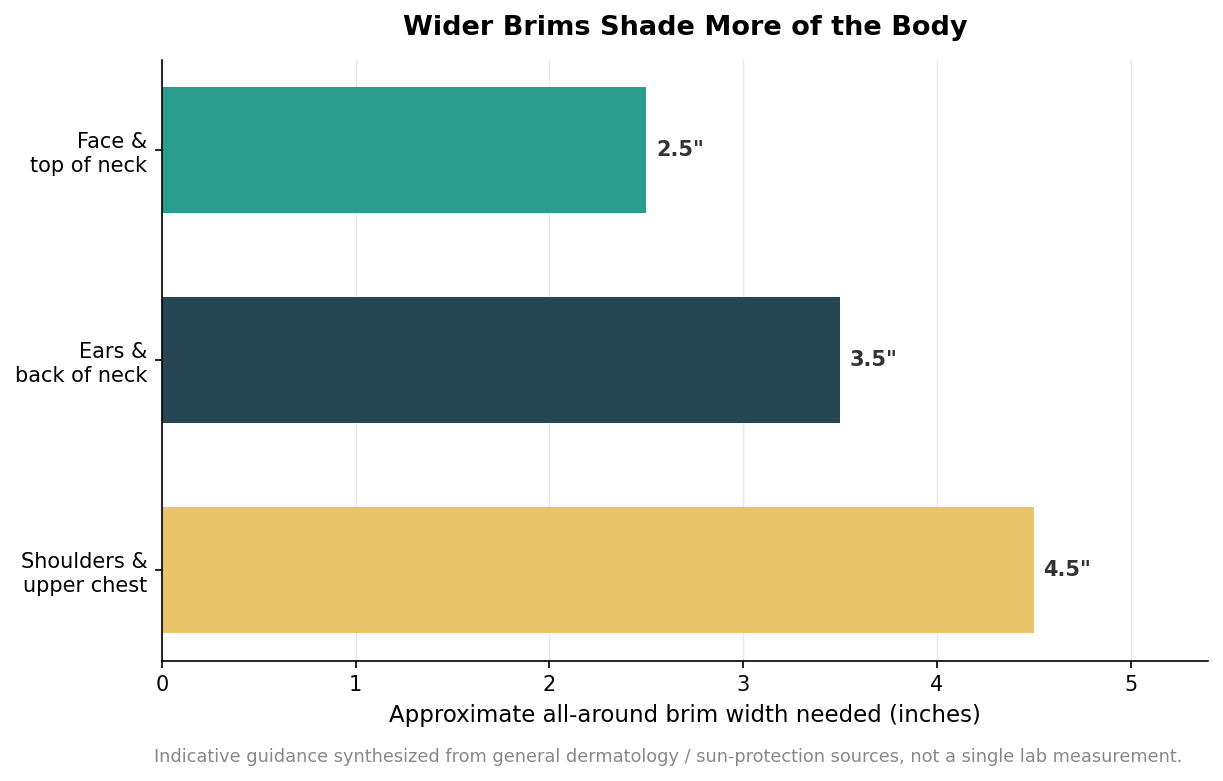
Even a perfectly opaque crown only protects what sits directly beneath it. The brim is what shades the face, ears, and neck, and its width sets the size of that shadow. General dermatology guidance points to a brim of at least three inches measured all the way around the hat, not just at the front. A brim in the two-to-three-inch range shields the face and the top of the neck; three to four inches brings the ears and the back of the neck into shade; four to five inches and beyond starts to cover the shoulders and upper chest as the sun moves across the sky.
The areas that narrow brims miss are not incidental. The ears and the back of the neck are among the most common sites where skin cancers are found, and they are exactly what baseball-style caps and visors leave exposed. If a hat is being issued so that people are actually protected rather than simply on-brand, brim width is not a styling detail to leave to the factory — it is a specification.
Color, Lining, and the Details That Add Up
Color matters more than most buyers expect. Darker and more saturated dyes absorb UV rather than letting it scatter through the weave, so a deep navy or black straw generally outperforms a pale natural of the same construction. An underbrim in a dark shade also cuts the reflected UV that bounces up from sand, water, and pavement into the face — a real source of exposure that a light underbrim does nothing about. Beyond the material itself, a chin cord that keeps the hat on in wind, a comfortable sweatband, and a crown that holds its shape all matter for one reason: they determine whether the hat is worn for the whole day or pushed back and taken off. Protection that ends up in a bag protects no one.
Specifying a Bulk Order That Actually Protects
If sun protection is a genuine requirement rather than a nice-to-have — a resort issuing hats to poolside staff, an events company outfitting a festival crew, a farm buying for field workers — put it in the specification instead of hoping the default product delivers it. Ask the supplier whether the material has been tested to AS/NZS 4399 or an equivalent method such as the US ASTM D6603 labeling standard, and request the UPF figure for the specific straw you are ordering rather than a general claim about the style. Set a minimum brim width in writing, and hold a pre-production sample up to the light yourself before you approve the run. Where reflected glare is a concern, specify a darker underbrim, and confirm the weave density on a physical sample rather than a photograph.
None of this adds much to a well-run order, and it is the whole difference between hats that look protective and hats that are. One honest note on the numbers above: the brim-to-coverage figures are a synthesis of general sun-protection guidance rather than a single laboratory measurement, so treat them as a starting point and confirm the specifics against your own samples and, where the stakes justify it, a real test report.